
If you are burying your pet at home, you must do so safely and responsibly to protect other animals, people, and the environment.
Key points
- You must own the land where your pet is buried.
- Think ahead — if you would want to take your pet’s remains if you move house, consider cremation or a burial that allows later exhumation.
- Avoid blankets or plastic — natural materials help the body decompose safely.
- Cover your pet with at least 2–3 feet of earth and protect the grave from being disturbed by pets or wildlife.
- If your pet was euthanased, disturbed graves can harm wildlife or other pets because euthanasia drugs remain in the soil.
- Do not bury pets that died from infectious diseases (e.g., parvovirus, leptospirosis). This can be dangerous for other pets, wildlife and people.
- Do not bury pets that died from infectious diseases (e.g., parvovirus, leptospirosis). This can be dangerous for other pets, wildlife and people.
Is it legal to bury my pet at home?
- In the UK you may bury a pet, but only on land you own. Renters must get the landowner’s permission.
- There are no national burial standards for small pets, but you may want to avoid areas near water sources or flood-prone gardens.
- Larger animals (e.g., horses and livestock) have specific rules, even if they are kept as pets. See gov.uk guidance for more information.
Is it safe to bury my pet at home?
- Euthanasia drugs (such as pentobarbital) can remain in soil for years, posing risks to wildlife and pets if disturbed. This can be fatal.
- Wildlife may dig up graves, causing distress and potential poisoning. To prevent this you must ensure the site is secure.
How should I bury my pet at home?
- Dig at least 3–4 feet deep so that your pet has 2-3 feet of earth between them and the surface.
- You can use concrete slabs and chicken wire within the grave to provide protection from other animals.
- Avoid areas that are likely to be disturbed in the future, such as flower beds.
- Avoid areas with tree roots, pipes, or wires.
- Mark the site with something permanent if you might want to locate it later. Taking photos of the site from different angles with a permanent fixture (e.g. shed, fence) can also help in locating the grave.
- Decomposition can take 1–3 years, depending on soil conditions.
What should I bury my pet in?
- Ideally bury your pet without coverings to allow decomposition to occur.
- Using a synthetic material (e.g., fleece blanket or a Euthabag®) allows decomposition to occur whilst keeping your pet’s remains together, which is a good option if you think you’d like to exhume your pet in the future. The Euthabag® can also be personalised with drawings and handwritten notes or poems. Please let us know if you’d like us to arrange a Euthabag® for you.
- Do not use plastic bags or baskets as they prevent decomposition and can harm the environment.
- If you choose to use a coffin avoid making one from plywood as this will cause the grave to become waterlogged. Try to choose materials that will naturally degrade over time.
- A thin layer of lime beneath and above the body can help with the natural decomposition process.
- You may wish to bury some flowers or some of your pet’s belongings with them.
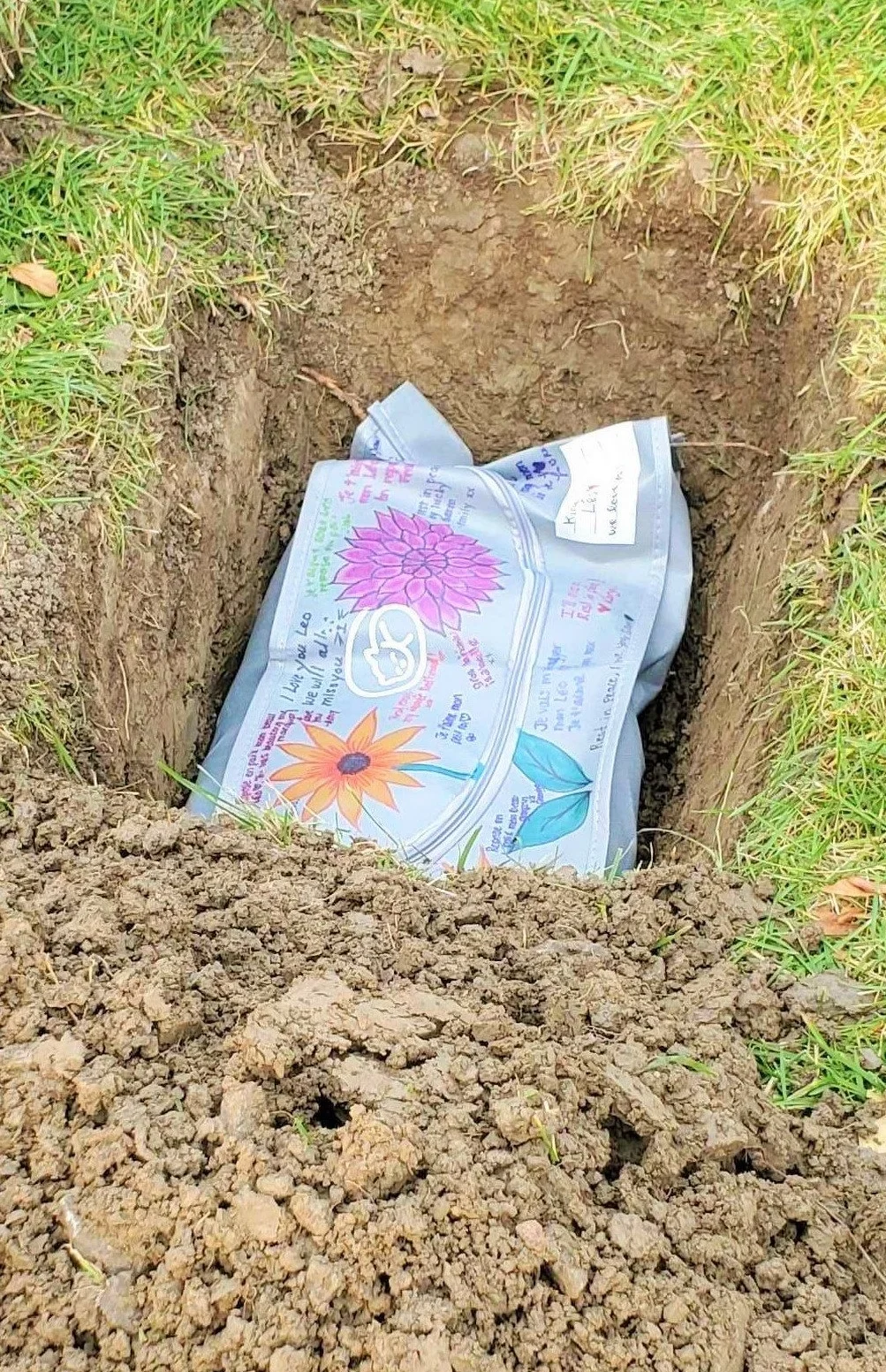
The Euthabag® can be decorated with drawings and messages to your pet
Alternatives to burying your pets at home
- Pet cemeteries can offer a peaceful option if home burial isn’t possible.
- You may also choose to bury ashes in a garden or plant pot, making them easier to take with you if you move.
If you need any more guidance please feel free to contact us.